The Signal
Black churches are usually discussed as moral, spiritual and political institutions.
They should also be understood as economic institutions.
Congregations collect recurring contributions, maintain buildings, employ staff, purchase goods and services, provide emergency assistance, support community programs and sustain relationships across generations.
That does not mean every church is wealthy. Many congregations operate with limited resources, aging buildings, small staffs and increasing demands from members and surrounding communities.
The serious question is not how much money Black churches supposedly control in the aggregate. Reliable evidence does not support a single universal figure.
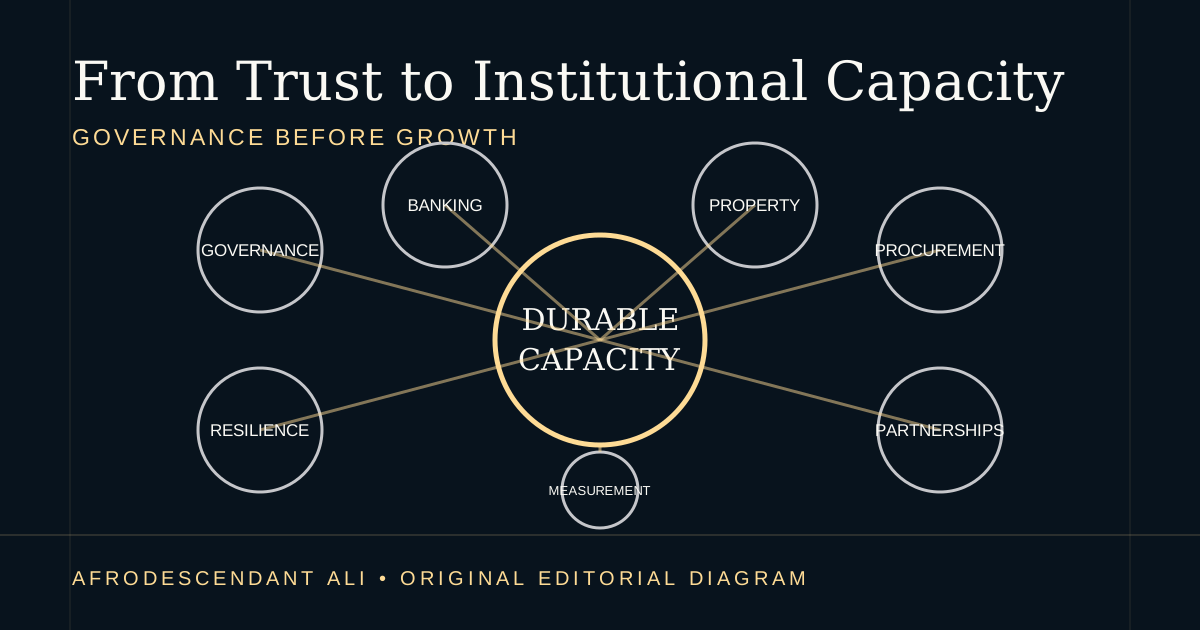
The serious question is how institutions convert trust, recurring activity and community presence into durable capacity.
This is not just about the offering plate. It is a test of governance, ownership, financial resilience and whether Black institutions can retain more of the value that moves through them.
What The Evidence Confirms
Pew Research Center found that 29 percent of Black adults had turned to a church or other religious congregation for help with bills, housing or food at some point in their lives.
Among Black adults with household incomes below $30,000, the share was 45 percent.
That finding shows the economic role congregations already play. Churches often function as emergency-response institutions long before a government agency, foundation or financial institution reaches a family.
Pew also found that roughly three-quarters of Black adults believed predominantly Black churches had contributed at least something to the movement toward racial equality.
Historically, Black congregations have supported more than worship. They have housed job training, insurance cooperatives, libraries, civic organizing, education and other community functions.
The institution already exists.
The strategic question is whether its economic systems are designed only to survive the next emergency or to build capacity that reduces future vulnerability.
From Relief To Capacity
Emergency assistance matters.
A church that helps a family keep electricity connected, avoid eviction or obtain food is performing necessary work.
But emergency relief and institutional development are not the same.
Relief responds after a crisis has reached a household.
Institutional development asks what systems could reduce the frequency or severity of those crises: financial education, access to safe banking, credit building, workforce partnerships, small-business support, affordable housing relationships and stronger community organizations.
The shift is not from compassion to business.
It is from repeated reaction to organized capacity.
That shift requires churches to examine not only what they give away, but how they govern the assets, relationships and recurring expenditures already under their control.
Seven Questions Of Institutional Capacity
The first question is governance.
Who authorizes major expenditures, borrowing, contracts and partnerships? Are decisions documented? Are financial and property responsibilities concentrated in one person, or supported by boards, committees and qualified professional review?
Mission does not remove the need for controls. Trust becomes stronger when responsibility is clear and records can be examined.
The second question is resilience.
Can the institution continue core operations during a disruption? A church may own property and still lack the liquid resources required to cover payroll, repairs, insurance or an unexpected decline in contributions.
Resilience is not accumulation for its own sake. It protects the institution’s ability to serve.
The third question is banking.
Are accounts held with regulated institutions? Are deposit structures, signatory controls and records reviewed regularly? Do banking relationships support the mission of the congregation and the economic needs of the surrounding community?
This is where relationships with Black-owned banks, credit unions and Community Development Financial Institutions may become relevant. No institution is automatically the right partner. Capacity, regulation, services, risk controls and mission fit must be evaluated.
The fourth question is property.
Church buildings and land can be sacred spaces, community centers and major long-term assets. They can also carry maintenance costs, insurance obligations, debt and unused capacity.
A property strategy asks whether space is supporting worship, education, health services, childcare, workforce development, housing partnerships or other mission-aligned uses.
The purpose is not to commercialize every sanctuary. It is to understand what the institution owns and whether that ownership is producing community value.
The fifth question is procurement.
Every congregation purchases products and services: food, printing, construction, technology, transportation, insurance, maintenance, media, professional services and supplies.
Procurement is one of the clearest places where values can become measurable economic practice.
How much recurring spending reaches qualified Black-owned and local vendors? Are vendors selected through transparent standards? Can smaller businesses meet the church’s needs without compromising quality, price or accountability?
Local circulation should not mean abandoning competition or controls. It means measuring whether institutional spending strengthens the community or immediately exits it.
The sixth question is partnership.
The FDIC’s Alliances for Economic Inclusion show that faith-based organizations can work with regulated financial institutions, community groups and government agencies around account access, financial education, credit building, small business and affordable housing.
The Federal Reserve describes community-development finance as a mix of public, private and philanthropic resources. Churches can serve as conveners, trusted referral points, hosts and community partners without becoming lenders or attempting to perform work beyond their competence.
The seventh question is measurement.
How many households received emergency support?
How many people completed financial education or workforce training?
How many referrals produced safe accounts, improved credit, employment or business assistance?
How much procurement reached qualified local vendors?
Which partnerships produced results, and which consumed time without creating value?
Without measurement, a congregation may be doing important work while remaining unable to explain its impact, improve its programs or attract credible partners.
Black Banks, CDFIs And Institutional Alignment
Black-owned banks and other minority depository institutions have historically served communities that mainstream finance often neglected.
Federal Reserve reporting notes that Black-owned banks are positioned to assist majority-Black communities, while also facing limits involving scale, technology, profitability and institutional capacity.
That means symbolic support is not enough.
A congregation deciding where to bank should examine safety, services, fees, digital capacity, lending relationships, community mission and the institution’s ability to meet operational needs.
The same discipline applies to CDFIs.
Community Development Financial Institutions may take the form of banks, credit unions, loan funds or other mission-driven organizations. They can support housing, small businesses and community facilities in areas where conventional capital is limited.
Churches can become valuable partners because they possess trust, physical presence and community knowledge. But partnerships should have defined goals, responsibilities, reporting and stop conditions.
Trust is an asset. It should not be transferred to a partner without accountability.
Property, Land And Community Use
For many Black congregations, property is the largest long-term asset and the largest long-term obligation.
A building may carry historical meaning that cannot be reduced to a market price. It may also be underused for most of the week while the congregation pays for maintenance, security, insurance and repairs.
A serious property review does not begin with selling.
It begins with mission.
What services does the community need?
What uses are legally and physically possible?
Could space support tutoring, childcare, health outreach, archives, meetings, business training or partnerships with community-development organizations?
What costs and liabilities would those uses create?
The objective is not to force every church into real-estate development. It is to prevent valuable property from remaining unexamined until a financial crisis makes the decision.
Governance Before Growth
Economic ambition without governance can damage the institution it is meant to strengthen.
Before expanding programs, purchasing property, entering partnerships or creating new entities, congregations need clear authority, accurate records and independent professional review where necessary.
Leaders should distinguish ministry decisions from legal, tax, accounting, banking and investment questions that require qualified expertise.
Transparency also protects the congregation’s moral authority.
Members should be able to understand the purpose of major initiatives, the risks involved, the people responsible and the method for measuring results.
Institutional capital is not only money.
It is trust, records, property, relationships, skills, reputation and the ability to make decisions that survive leadership transitions.
Why It Matters To The Black World
Across the Black World, communities often possess strong social networks but weak institutional balance sheets.
Churches, mosques, mutual-aid societies, cultural associations and hometown organizations may carry enormous trust while lacking the systems required to retain capital, document outcomes and negotiate with larger institutions.
The Black church is one important example because it has historically been among the institutions Black Americans controlled most consistently.
The next stage is not to reduce the church to a business.
It is to recognize that spiritual mission, civic responsibility and institutional competence should reinforce one another.
A church that governs well can remain present through crisis.
A church that measures its community work can attract stronger partners.
A church that understands its property and procurement can direct more value toward its mission.
A church that teaches financial capability while practicing transparent stewardship strengthens its credibility.
What To Watch Next
Serious Black church economic analysis should move away from unsupported claims about how much money churches collectively possess.
Watch governance quality.
Watch property decisions before crisis.
Watch procurement and local vendor participation.
Watch partnerships with regulated banks, credit unions, CDFIs and housing organizations.
Watch whether financial education connects people to safe products and measurable outcomes.
Watch whether institutions preserve records and plans across pastoral and board transitions.
The offering plate is a recurring act of trust.
The institutional question is what systems transform that trust into durable service, ownership and community capacity.
Sources And Methodology
This article relies on research from Pew Research Center, the Federal Deposit Insurance Corporation, the Federal Reserve and the Urban Institute. It is a strategic institutional framework, not individualized legal, tax, investment or fiduciary advice. It does not reproduce or rely on the Dick Gregory clip that prompted the original topic.
Turn trust into durable institutional capacity
Request a media and intelligence system audit for a controlled review of governance, evidence, workflows, communication and value retention.
Request a system audit