The Signal
Black World knowledge is abundant, but it is not always secure.
Civil-rights records, reparations research, historical archives, economic analysis and political reporting are scattered across websites, PDFs, video platforms, social feeds and private working files. Links change. Pages disappear. Search results shift. Platform algorithms decide what rises and what remains buried.
For an independent media operation, that creates a structural problem. A researcher can find an important source one week and struggle to reconstruct the same evidence trail later. A social post may produce attention without leaving behind an organized record. A promising article can stall because the underlying source material was never preserved in a form that another editor can inspect.
This is not just a technology problem. It is a question of institutional memory, evidence control and whether Black media can retain the knowledge it works to discover.
What Was Built
Afrodescendant Ali developed a bounded source-ingestion system designed to collect limited information from a controlled list of Black World sources.
The word bounded matters.
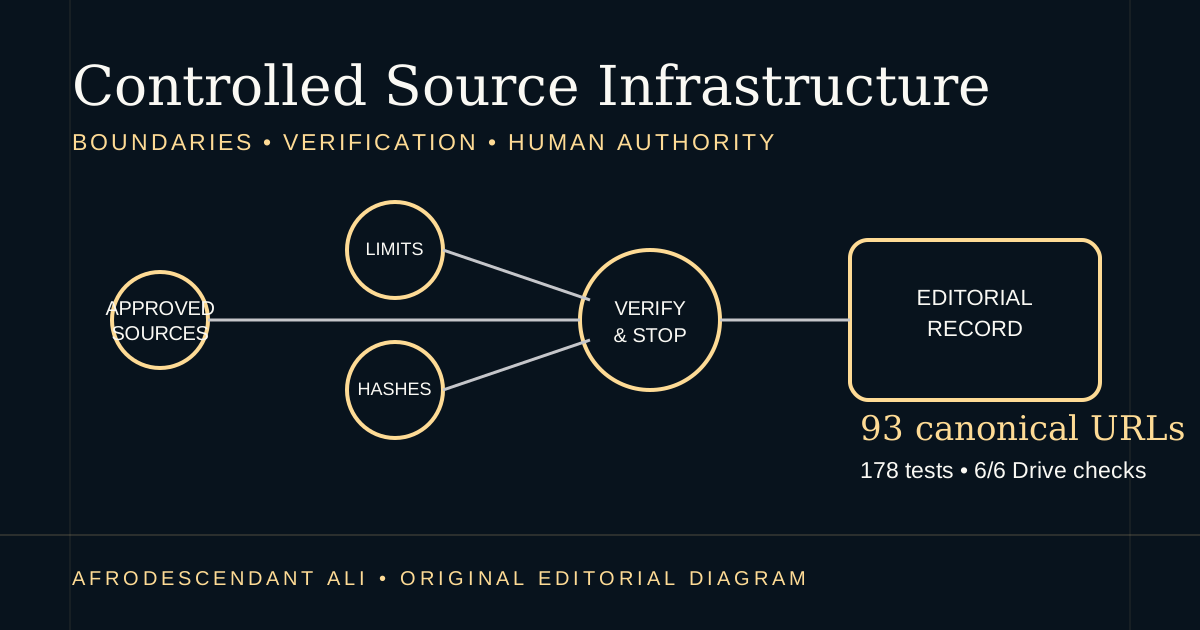
The system was not designed to crawl everything it could reach. It operated from an approved source list, imposed source-level and aggregate limits, recorded canonical URLs, retained short excerpts, generated content hashes and exported structured records into controlled storage.
The purpose was not to create a machine that decides what is true. The purpose was to create a more reliable intake layer: a system that could preserve where information came from, distinguish new material from duplicates and leave a record that could be reviewed later.
That distinction separates useful automation from uncontrolled collection.
What Was Confirmed
The bounded production run covered five approved sources and produced an index containing 93 unique canonical URLs.
Drive verification passed six of six checks. Content hashes were present for the indexed records. Excerpts were limited to no more than 400 characters. The system’s local-storage audit found no prohibited research files in the controlled validation record.
The engineering work also replaced a vague “pages stored” count with explicit metrics. The system began recording how many pages were discovered, attempted, fetched, uploaded, inserted, updated, unchanged, duplicated or failed.
That correction matters because a media organization should not confuse activity with growth. A crawler can visit a page without adding a new source to the index. It can upload a record that is unchanged. It can encounter a duplicate. Without reconciled metrics, a large activity number can create the appearance of progress without showing what actually changed.
The final regression suite reported 178 passing tests. A controlled validation then demonstrated that the index could remain at 93 records while the metrics correctly reported one discovered, fetched and uploaded page as unchanged rather than falsely presenting it as a new insertion.
The System Underneath
The most important result was not the number 93.
The deeper result was the control structure around it.
A serious source system must answer several questions before it collects anything:
Which sources are permitted?
What material may be stored?
How much of a page may be retained?
How are duplicates identified?
What happens when a source blocks access?
What happens when a verification check fails?
Who decides whether the collected material is accurate, fair or publishable?
The answer to the final question remains human.
Automation can preserve an evidence trail. It can organize metadata. It can detect duplicates and enforce limits. It cannot determine whether an allegation is established, whether a quotation is in context, whether an image may be reused or whether a story meets the publication standard of a Black World intelligence desk.
Those remain editorial decisions.
Why The Pause Matters
The system was eventually placed on a weekly schedule. That scheduled worker was later stopped when the workstation shifted to battery power during an attempted run. A subsequent operational audit disabled and quarantined the recurring task pending a separately approved redesign.
The available record did not establish a failure in the crawler’s underlying code. It did establish that the scheduled operating environment was not reliable enough to treat the recurring process as healthy.
That pause is part of the lesson.
A controlled system should stop when its operating conditions become uncertain. It should preserve the evidence, identify the failure boundary and require a deliberate decision before restarting. Silent continuation would be more dangerous than a documented interruption.
The goal is not automation at any cost. The goal is infrastructure that can explain what it did, what it did not do and why it stopped.
Why It Matters To The Black World
Black communities generate vast amounts of knowledge: court records, family testimony, organizing history, political analysis, economic research, archival footage, institutional reports and public memory.
Too much of that knowledge remains dependent on systems Black communities do not control.
Social platforms can remove accounts. Search engines can change ranking priorities. Newsrooms can close. Websites can be redesigned without preserving their archives. Important records can remain technically public while becoming practically invisible.
Owned source infrastructure does not solve every problem, but it strengthens several forms of Black institutional power.
It supports historical memory by preserving source locations and changes over time.
It supports civil-rights and human-rights reporting by making evidence trails easier to reconstruct.
It supports reparations research by organizing institutional records across multiple organizations.
It supports editorial consistency by giving writers and reviewers a shared source base.
It supports search authority by turning scattered research into durable, structured knowledge.
It also supports commercial credibility. A media and intelligence organization that can demonstrate source controls, verification rules and reproducible workflows is offering more than commentary. It is offering a system.
What The System Does Not Do
The source infrastructure does not automatically verify truth.
It does not make every source credible.
It does not create publication rights over material found online.
It does not replace reporters, editors, historians, attorneys or affected communities.
It does not eliminate the need to separate confirmed facts from allegations and interpretation.
It does not authorize unlimited collection.
These limits are not weaknesses. They are the conditions that keep the system useful.
What To Watch Next
The next phase is not simply to switch the weekly task back on.
The recurring worker needs a redesigned operating model that accounts for workstation power state, network availability, scheduler behavior and the current storage policy. The first controlled recurring runs should be reviewed manually for source changes, unique URL counts, verification results and prohibited-file checks.
The larger editorial challenge is equally important: converting source records into article-ready packets with claim registers, source classifications, rights decisions and clear publication gates.
That is where infrastructure becomes journalism.
A source system creates value only when it helps serious editors move from discovery to verification, from verification to analysis and from analysis to durable public knowledge.
For organizations building research, media or knowledge systems, automation is only one layer. Source controls, evidence rules, storage discipline and clear human authority are what make the system trustworthy.
Sources And Methodology
This article is based on the Afrodescendant Ali Black World Source Ingestor completion, validation, source-index and scheduled-task audit records dated July 14–19, 2026. Private identifiers, local paths, authentication details and internal Drive references have been excluded from the public manuscript.
Need a controlled research system?
Request a media and intelligence system audit when the problem is not one article, but the entire source-to-publication workflow.
Request a system audit