The Signal
On July 17, 2014, Eric Garner died after an encounter with New York City police officers in Staten Island.
His final words became part of the language of protest across the United States and beyond. But twelve years later, the deeper question is not only what the public remembers. It is what the accountability system actually did.
The answer cannot be reduced to one verdict.
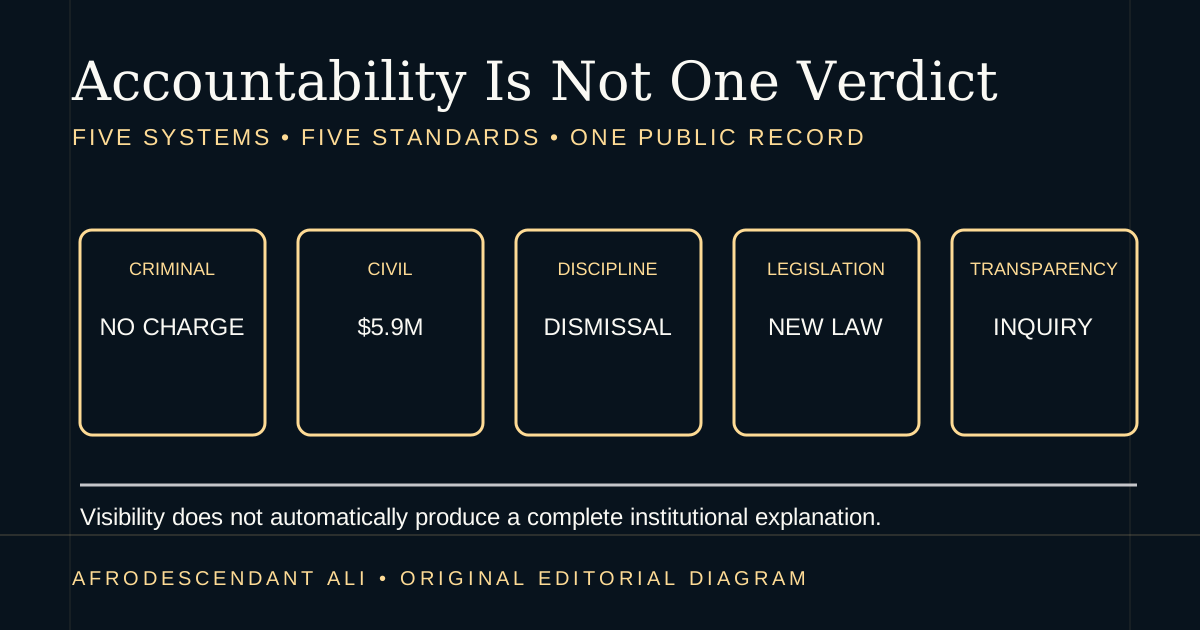
Garner’s case moved through separate criminal, civil, disciplinary, legislative and judicial-transparency systems. Each applied a different legal standard. Each moved on a different timetable. Each produced a different form of consequence.
This is not just the history of one fatal arrest. It is a map of how American institutions divide responsibility after a Black person dies during police action.
What Is Confirmed
A Staten Island grand jury declined to return an indictment in 2014.
The U.S. Department of Justice then conducted a federal criminal civil-rights investigation. In July 2019, federal prosecutors announced that they would not bring charges because they concluded the available evidence was insufficient to prove a violation of the federal criminal civil-rights statute beyond a reasonable doubt.
That was a criminal charging decision. It did not determine every question concerning policy, discipline, official reporting or institutional transparency.
New York City also reached a $5.9 million pre-litigation settlement with Garner’s estate in 2015. The city did not admit liability. A civil settlement resolves a claim; it is not a criminal conviction and does not carry the same evidentiary meaning.
The NYPD disciplinary system produced a different result.
After an administrative trial, the department’s deputy commissioner of trials found by a preponderance of the evidence that Officer Daniel Pantaleo recklessly caused injury by maintaining a prohibited chokehold after the immediate exigency had ended. The recommendation was dismissal.
Police Commissioner James O’Neill accepted that recommendation and fired Pantaleo in August 2019. A New York appellate court later upheld the dismissal.
Five Accountability Tracks
The Garner case is easier to understand when the outcomes are separated.
The first track was local criminal law. The grand jury did not indict.
The second was federal criminal civil-rights law. The Justice Department closed the investigation without charges because prosecutors said they could not meet the beyond-a-reasonable-doubt standard.
The third was civil liability. The city paid a settlement while denying an admission of liability.
The fourth was employment discipline. The NYPD applied an administrative standard and dismissed Pantaleo.
The fifth was law and institutional reform. New York enacted the Eric Garner Anti-Chokehold Act in 2020, creating the offense of aggravated strangulation when a police or peace officer uses a chokehold or similar restraint and causes serious physical injury or death.
These outcomes did not contradict one another simply because they differed. They arose from different systems asking different questions.
A criminal court asks whether prosecutors can prove a charged crime beyond a reasonable doubt.
A civil settlement may reflect litigation risk, public interest and negotiated resolution without an admission of liability.
An employment tribunal asks whether an employee violated departmental rules under an administrative evidentiary standard.
A legislature asks whether existing law is adequate for future cases.
The larger failure is that the public often receives these outcomes as disconnected headlines rather than as one institutional record.
Publicity Is Not Transparency
Years after Garner’s death, his mother, Gwen Carr, and other petitioners sought a rare judicial inquiry under the New York City Charter.
They argued that major questions remained concerning the conduct of officers other than Pantaleo, official documents about the arrest, possible leaks of confidential information and the medical response.
In 2021, a New York appellate court allowed that inquiry to proceed.
The court made a distinction that reaches beyond this case: publicity is not the same as transparency.
The arrest had been viewed, discussed and reported around the world. Yet the court concluded that only a narrow set of issues concerning Pantaleo had been definitively and publicly addressed. Extensive media attention had not produced a complete institutional explanation.
That is a central lesson of the Garner record.
A video can make an event visible. It cannot force every agency to explain what it did afterward.
A settlement can compensate a family. It cannot substitute for criminal findings or public disclosure.
A disciplinary decision can remove one officer. It cannot automatically resolve questions concerning other officials, reporting practices, medical response or institutional culture.
The Law That Followed
The Eric Garner Anti-Chokehold Act created a new state criminal offense for police and peace officers whose use of a chokehold or similar restraint causes serious physical injury or death.
The law matters because it attempted to close a gap between departmental prohibition and criminal accountability.
Pantaleo’s disciplinary record showed that the NYPD already prohibited chokeholds. But a policy rule and a criminal statute do different work. A department can discipline an officer for violating its procedures. A prosecutor needs a defined offense and evidence sufficient to prove every element of that offense.
The existence of the law does not guarantee enforcement. It does establish a clearer legal framework for future cases.
Why It Matters To The Black World
Eric Garner’s case belongs to a wider Black World history of state force, public evidence and delayed institutional response.
Black families are often required to become investigators, archivists, public advocates and legal strategists while grieving. They must preserve video, track agencies, compare official statements, obtain records and keep public attention alive across years.
That burden is itself part of the system.
The Garner case also shows why Black media must distinguish forms of accountability. A headline saying that an officer was “cleared” can erase the difference between a criminal charging decision and a later disciplinary finding. A headline saying that a family “won” a settlement can obscure the absence of an admission of liability. A law named after a victim can be presented as closure even when broader transparency questions remain.
Serious coverage must preserve those distinctions.
What The Record Produced
The accountability system produced consequences, but not a single comprehensive judgment.
It produced no local or federal criminal charge against Pantaleo.
It produced a civil settlement.
It produced an administrative finding and dismissal.
It produced an appellate decision sustaining that dismissal.
It produced a state anti-chokehold law.
It produced a judicial recognition that substantial questions had remained outside public investigation and explanation.
That record is neither “nothing happened” nor “justice was completed.”
It is a fragmented result in which different institutions answered different parts of the case while the family and public carried the burden of connecting them.
What To Watch Next
Future police-accountability cases should be tracked across the same institutional lanes from the beginning:
What criminal investigation is open?
What civil claim has been filed or settled?
What internal disciplinary process exists?
What records remain withheld?
What policy or legislation followed?
What questions were never assigned to any institution at all?
That final category is often where accountability disappears.
Eric Garner’s death became visible because it was recorded. The years that followed show that visibility must still be converted into documentation, legal pressure and public explanation.
Sources And Methodology
This analysis relies on official records from the U.S. Department of Justice, the New York City Police Department, the New York City Comptroller, the New York State Legislature and New York appellate courts. It does not reproduce the arrest video or third-party photographs.
Track the full accountability record
Subscribe for Black World analysis that separates public evidence, legal standards, institutional outcomes and unresolved questions.
Subscribe to briefings