The Signal
Martin Luther King Jr. is often remembered through the language of moral appeal, nonviolence and racial integration.
That memory is incomplete.
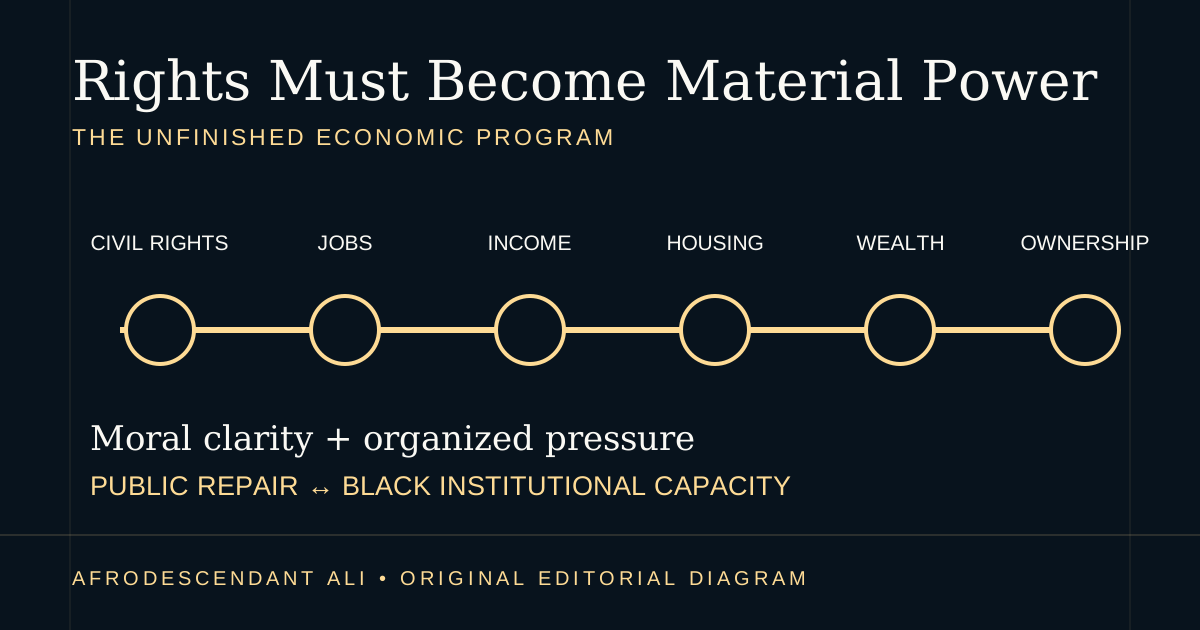
By the final years of his life, King was moving the civil-rights struggle directly into the structure of the economy. He was asking what legal freedom meant without secure work, adequate income, decent housing, bargaining power and the ability to build wealth.
The Poor People’s Campaign was not an afterthought. It was the next stage of his political analysis.
This is not just a historical question about what King believed. It is a test of whether the United States ever completed the movement from formal civil rights to material security.
What The Poor People’s Campaign Demanded
King announced the Poor People’s Campaign after a Southern Christian Leadership Conference staff retreat in November 1967.
The campaign planned to bring poor people to Washington and press federal institutions for jobs, unemployment insurance, a fair minimum wage and education for poor adults and children.
It was designed as a multiracial movement. African American organizers worked alongside Indigenous, Puerto Rican, Mexican American and poor white communities. King understood that poverty crossed racial lines, but he did not erase the specific history of Black economic deprivation.
The organizing premise was simple: legal rights could not become full citizenship without economic security.
Desegregation could open a door. It could not guarantee the income required to walk through it.
Voting rights could increase political power. They did not automatically produce jobs, housing or accumulated wealth.
The Poor People’s Campaign therefore moved beyond access. It targeted the distribution of resources and the institutions that controlled them.
The System Underneath
King’s late economic program was not based on private charity alone.
It was built around organized pressure on Congress and federal agencies.
The campaign intended to bring poor people into direct contact with the institutions responsible for employment, housing, food, education and economic policy. Participants would not simply request sympathy. They would create a public crisis that government could no longer avoid.
King had learned that moral argument without organized pressure rarely moved entrenched power.
That lesson remains central to Black political economy.
A community may clearly document unemployment, unaffordable housing or unequal wealth. But evidence becomes leverage only when institutions face a cost for ignoring it: legal action, organized voting, labor pressure, sustained media attention, budget demands or direct political mobilization.
King’s method connected moral clarity to institutional pressure.
Jobs Or Income
The campaign’s demand for jobs or income is especially important.
It recognized that economic dignity cannot depend entirely on whether private employers provide enough stable work at adequate wages. The campaign treated income security as a public responsibility.
That argument remains unresolved.
The United States has expanded some forms of social protection since 1968, but insecurity remains built into the labor and welfare systems. Millions of people work in low-wage jobs, face unstable schedules or remain one emergency away from financial crisis.
The national official poverty rate was 10.6 percent in 2024. The Supplemental Poverty Measure, which accounts for factors including taxes, benefits and housing costs, was 12.9 percent.
Those numbers do not measure the full experience of insecurity. A household can live above the official poverty line and still lack savings, affordable housing, health security or the ability to withstand job loss.
King’s program asked a larger question than whether people were officially poor. It asked whether they possessed the material conditions for a decent life.
The Wealth Question
Income pays current bills. Wealth creates time, choice and protection.
Federal Reserve analysis of the 2022 Survey of Consumer Finances found that the median wealth gap between White and Black families exceeded $220,000. The typical Black family held roughly $16 in wealth for every $100 held by the typical White family.
That gap reflects more than personal spending choices.
Wealth accumulates through homeownership, inheritance, business equity, retirement accounts, access to credit and public policies that determine which families can convert income into durable assets.
This is where King’s economic program meets the present.
Civil rights can prohibit discrimination. They cannot by themselves transfer assets, repair inherited exclusion or guarantee access to appreciating property.
A society can become formally more equal while remaining structurally unequal in ownership.
Black Cooperative Capacity
King did not place every responsibility on government.
In earlier writing, he also urged Black communities to save systematically and pool resources through cooperative institutions such as credit unions, savings and loan associations and finance companies.
That part of his thinking is often separated from the Poor People’s Campaign, but the two belong together.
One side concerns public responsibility: jobs, income, wages and federal action.
The other concerns Black institutional capacity: savings, cooperative finance, ownership and the ability to circulate resources within communities.
Neither side is sufficient alone.
Community self-help cannot erase discriminatory markets, unequal public investment or the accumulated effects of exclusion.
Government programs cannot create durable Black power if communities remain without institutions capable of retaining, directing and multiplying resources.
The strategic question is not government or self-reliance. It is how public repair and Black institutional ownership reinforce each other.
Why King’s Economic Program Was More Dangerous
A movement for access can be absorbed into existing institutions.
A movement for redistribution changes who controls resources.
That is why King’s late program created a different level of political pressure.
Jobs, income, wages and housing are not symbolic questions. They concern budgets, property, corporate power, taxation and the authority of government to intervene in markets.
King was no longer asking only whether Black people could enter public facilities or cast ballots. He was asking whether American democracy would reorganize economic life so that poor people could live with dignity.
That question remains unsettled because it reaches the foundation of power.
Why It Matters To The Black World
The relationship between formal rights and material power extends across the Black World.
African Americans may possess citizenship and voting rights while facing persistent wealth inequality.
Caribbean states may possess political independence while remaining constrained by debt, trade dependence and external finance.
African states may control territory while foreign institutions retain disproportionate power over minerals, data, credit and supply chains.
Afrodescendant communities across the Americas may win legal recognition while remaining excluded from land, capital and institutional investment.
The common issue is the distance between recognition and capacity.
King’s economic program matters because it refused to treat dignity as complete when the material structure remained unchanged.
What Remains Unfinished
The unfinished work is not one policy.
It is the larger architecture of economic security.
Can work provide a stable life?
Can families survive unemployment or illness without collapse?
Can Black households accumulate assets rather than remain trapped in permanent vulnerability?
Can communities create and control financial institutions?
Can public policy repair exclusion rather than merely prohibit future discrimination?
Can poor people build enough organized pressure to force economic questions into the center of national politics?
These were not secondary issues in King’s final campaign. They were the next battlefield.
What To Watch Next
Serious economic-justice reporting should track more than headline poverty rates.
Watch wages after housing and health costs.
Watch household wealth, debt and emergency savings.
Watch access to credit and business capital.
Watch the strength of Black banks, credit unions, cooperatives and community-development institutions.
Watch whether public spending creates ownership or only temporary consumption.
Watch whether civil-rights organizations treat economic structure as central rather than optional.
King’s economic program remains unfinished because the nation adopted much of the language of equality without completing the transfer of security, ownership and power that equality requires.
Sources And Methodology
This article relies on records from the Martin Luther King, Jr. Research and Education Institute, the National Archives, the U.S. Census Bureau and the Federal Reserve. It does not reproduce or depend on the recent interview clip that prompted the original article concept.
Follow rights, capital and institutional power
Subscribe to Afrodescendant Ali Briefings for evidence-led Black World political economy analysis.
Subscribe to briefings