The Signal
Historical memory is never only about the past.
It determines who appears as a builder of civilization, who is treated as a footnote and which people are taught to see themselves as actors in world history.
For generations, Black independent scholars challenged narratives that placed Africa outside the center of historical development. J. A. Rogers and John Henrik Clarke became important figures in that struggle because they refused to accept a version of world history in which African people appeared mainly as subjects of conquest, slavery or colonial rule.
The history of Kush shows why that work mattered.
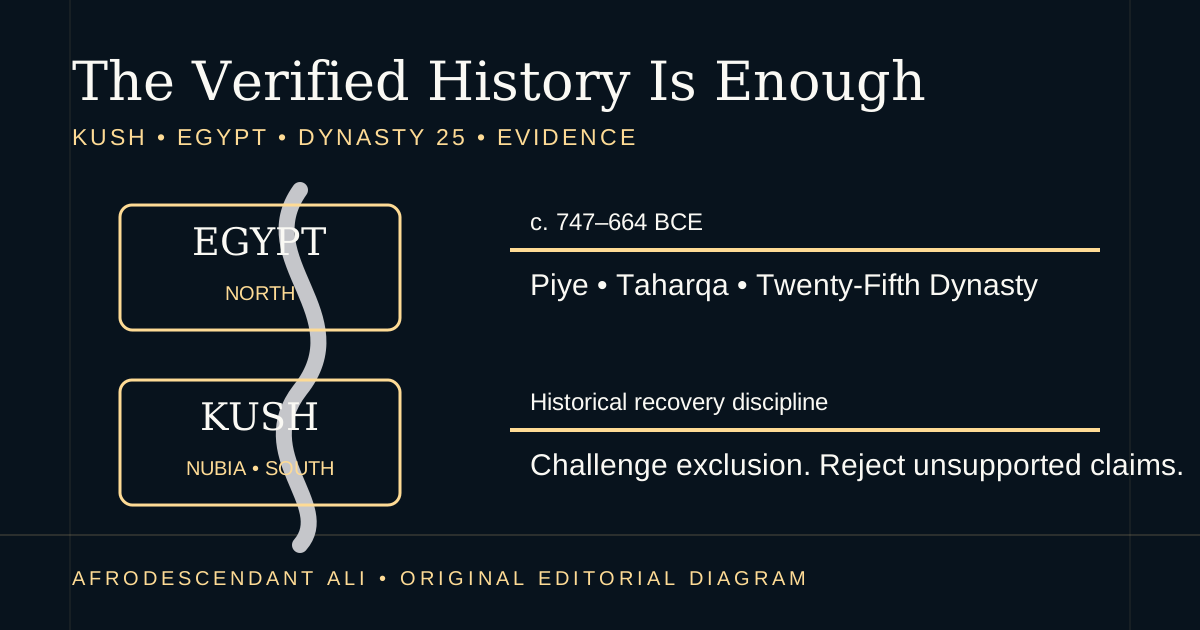
Kushite rulers from the region south of Egypt governed Egypt during the Twenty-Fifth Dynasty. Piye and Taharqa are documented rulers associated with that period. Museum records, archaeological objects and historical chronologies preserve the evidence.
This is not just a debate over ancient identity. It is a test of how Black historical recovery can combine intellectual independence with evidentiary discipline.
The Verified Kushite Record
Kush was a major African political formation centered in Nubia, in the Nile Valley south of Egypt.
By the eighth century BCE, Kushite rulers had extended their power northward. The rulers associated with Egypt’s Twenty-Fifth Dynasty brought large parts of Egypt under their authority during a period of political fragmentation.
The Metropolitan Museum of Art identifies the Twenty-Fifth Dynasty as Kushite. Its collection includes a scarab bearing the names of Piye and Taharqo and dates the Kushite dynasty broadly to approximately 747–664 BCE.
The British Museum identifies Taharqo, also widely rendered as Taharqa, as a Nubian ruler of Egypt’s Twenty-Fifth Dynasty.
These are not modern inventions created to satisfy a political need. They are part of the documented historical record.
The important point is not that Kushite rule makes Egypt simple. Ancient Egypt and Nubia had long and changing relationships involving trade, cultural exchange, rivalry, war, religion and political power.
The point is that African rulers from Kush were not peripheral observers. They became rulers of Egypt and participants in the political conflicts of the wider ancient world.
Piye, Taharqa And Dynasty 25
Piye is associated with the expansion of Kushite authority into Egypt. Later rulers consolidated the dynasty’s power.
Taharqa became one of its best-known kings. He ruled Kush and Egypt and was involved in the regional struggle created by Assyrian expansion.
British Museum records describe the Kushite kings as ending Egypt’s fragmented political condition by about 715 BCE. They also note that the later rulers Taharqa and Tanutamun were ultimately displaced from Egypt by the Assyrians and withdrew southward.
That history is significant without turning Kush into an unlimited empire.
The verified evidence supports Kushite rule in Egypt and participation in conflicts extending into the Levant and the Assyrian sphere. It does not support claims of direct rule far beyond that record.
Historical recovery becomes weaker, not stronger, when a documented achievement is burdened with claims that cannot be supported.
Why J. A. Rogers Mattered
J. A. Rogers was an independent historian and journalist whose work placed African and African-descended people inside world history.
Smithsonian Libraries records preserve his authorship of works including 100 Amazing Facts About the Negro and the multi-volume Sex and Race.
Rogers worked outside many of the institutions that traditionally decided who counted as an authority. His method was wide-ranging, popular and sometimes controversial. But his larger intervention was clear: Black people had to investigate the historical record for themselves rather than wait for institutions shaped by racial exclusion to tell the complete story.
That intervention mattered because historical omission is not neutral.
When African achievements are excluded, Black communities are asked to build identity from a record dominated by enslavement, colonialism and oppression. Those histories must be remembered, but they are not the whole archive.
Rogers helped popularize a wider field of inquiry: African presence, African agency and the global history of Black people.
Why John Henrik Clarke Mattered
John Henrik Clarke carried historical recovery into education, organization and institution building.
He treated history as a tool of political consciousness. For Clarke, the question was not merely whether individual facts about Africa could be added to an existing curriculum. The deeper issue was who designed the curriculum, whose perspective organized it and whether Black people possessed institutions capable of producing their own scholarship.
That approach helped shape the development of Africana Studies and independent Black educational work.
Clarke’s importance was therefore larger than any single claim about ancient history.
He represented a model of the scholar as institution-builder: someone who connected archival research, public teaching, political education and the creation of intellectual spaces outside established academic boundaries.
The Discipline Of Historical Recovery
Black historical recovery has often developed under hostile conditions.
Black scholars have had to challenge institutions that ignored African evidence, minimized African civilizations or treated European interpretation as automatically authoritative.
That struggle created a justified suspicion of inherited narratives.
But suspicion cannot replace method.
A mature Black historical practice must be willing to do two things at once:
Challenge exclusion.
Reject unsupported claims, including claims that appear politically useful.
The Afrodescendant Ali campaign that led to this article made that distinction. It retained the verified history of Kushite rule while refusing to present a broader territorial claim about Taharqa as established fact.
That is not a retreat from Black historical assertion. It is how authority is built.
A claim becomes more useful when readers can examine its source, understand its limits and distinguish evidence from interpretation.
Why It Matters To The Black World
The struggle over Kush is part of a wider struggle over historical memory across the Black World.
African Americans have fought to recover histories excluded from segregated schools and national narratives.
Caribbean societies have worked to reconnect slavery and colonialism to longer African histories.
Afro-Latino communities continue to challenge national identities that minimize African ancestry and Black political presence.
African states still confront colonial-era museum systems, archives and academic categories that placed African knowledge under external control.
Historical recovery therefore concerns power in the present.
Who owns the archive?
Who interprets archaeological evidence?
Who trains the next generation of historians?
Who decides which objects remain in foreign museums?
Who can convert historical knowledge into education, publishing, tourism, cultural confidence and institutional authority?
These questions turn memory into political economy.
The Verified History Is Enough
There is a temptation to believe that Black historical recovery must produce the largest possible claim.
That is unnecessary.
The documented history is already substantial.
A Kushite dynasty governed Egypt.
African rulers shaped the politics of the Nile Valley and confronted one of the major military powers of the ancient Near East.
Black independent scholars challenged generations of public education that excluded African agency.
Africana Studies developed partly through the work of scholars who refused to leave Black history at the margins.
None of that requires an invented portrait, an exaggerated map or an unsupported conquest claim.
The evidence is powerful because it can withstand examination.
What To Watch Next
Serious historical-memory work should continue in four directions.
First, strengthen access to primary records, museum catalogs, archaeological reports and reliable translations.
Second, build Black-controlled digital archives and research tools that preserve source trails.
Third, teach readers how to distinguish evidence, interpretation and political framing.
Fourth, convert recovered history into durable institutions: schools, reading programs, documentaries, museums, publishing projects and research centers.
The work of Rogers and Clarke was not simply to tell Black people that they had a past.
It was to insist that Black people had the responsibility to investigate, interpret and institutionalize that past for themselves.
Sources And Methodology
This article relies on the Afrodescendant Ali Clarke–Rogers campaign closeout, Metropolitan Museum of Art and British Museum records concerning the Twenty-Fifth Dynasty, and Smithsonian Libraries bibliographic records for J. A. Rogers. It does not reproduce the archival video, campaign portraits or generated likenesses.
Build historical memory that can withstand examination
Subscribe for Black World analysis of archives, institutions, historical recovery and cultural power.
Subscribe to briefings